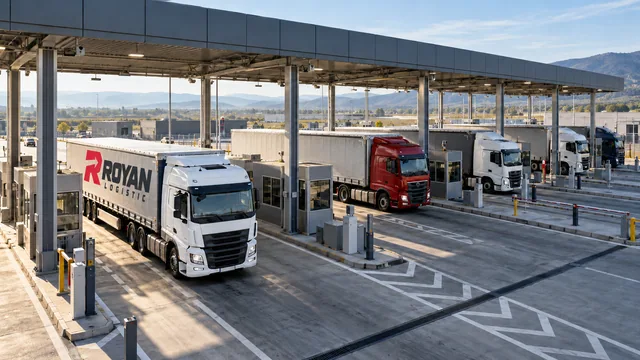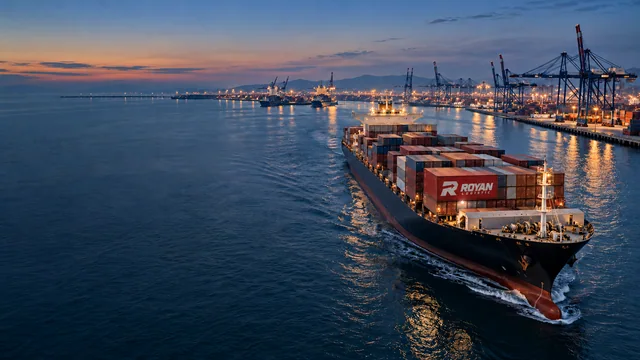
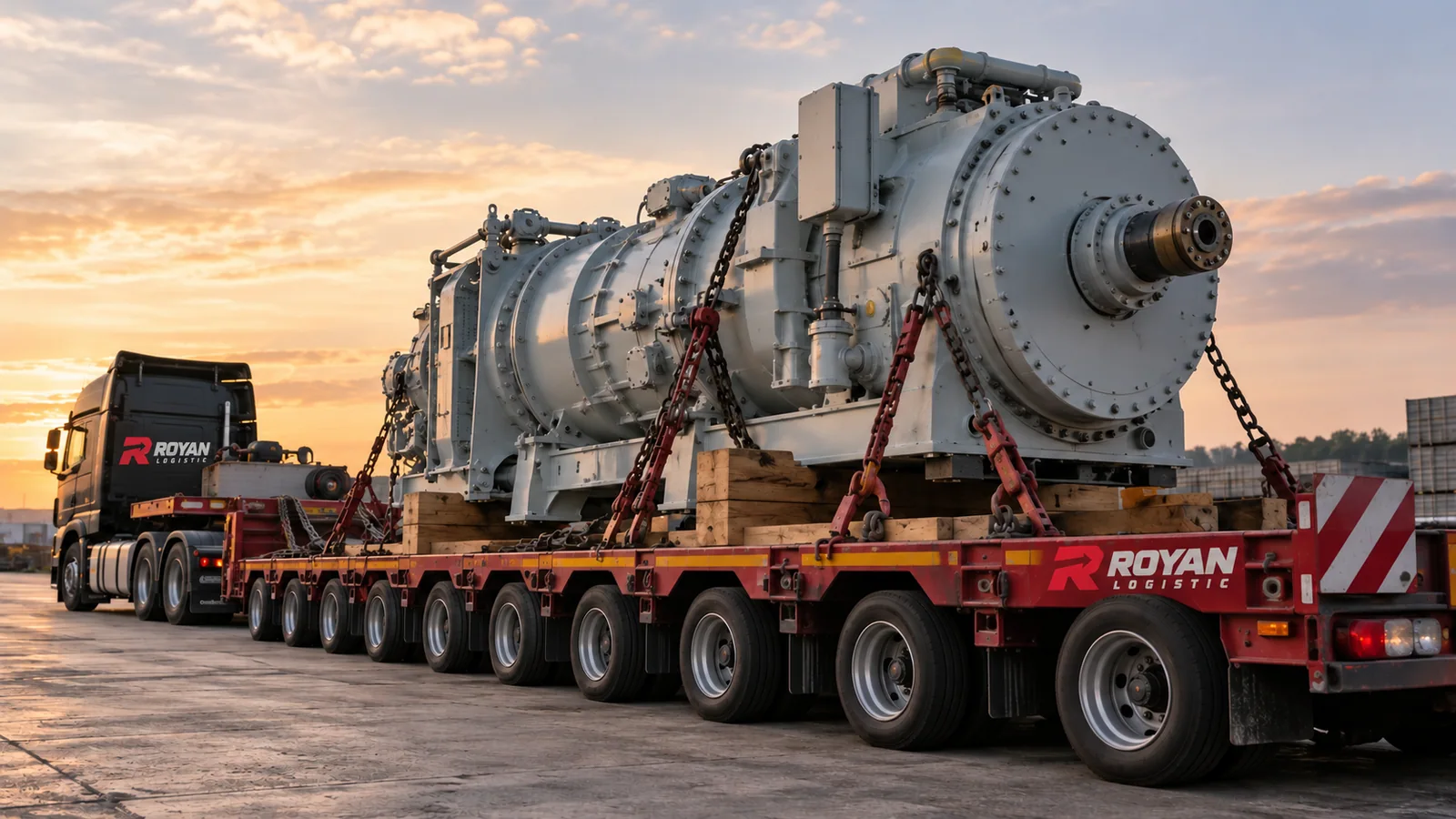
Project cargo and out-of-gauge transport cover machinery, equipment and structures that exceed standard trailer dimensions or legal weight limits and need a dedicated plan for every move. Royan Logistic, headquartered in Tehran, Iran, plans project cargo into, out of and through Iran, organising port handling, route surveys, permits from every country on the route, escorts, suitable vehicles, lifting equipment and customs documents in one shipment plan.
What we do on a project shipment
Finding a truck is the easy part. The real task is showing early that the cargo can legally and physically pass along the whole route, and obtaining each country's permit in the right order. On each move we:
- Collect technical data: net dimensions, weight, centre of gravity, lifting and lashing points, sensitive areas and removable parts, based on the manufacturer's drawing.
- Ask about dismantling: removing one part can bring the cargo within standard limits and reduce permit and escort needs. This is assessed with the manufacturer or installation team.
- Plan vehicle and equipment: lowbed, semi-lowbed, extendable trailer or, for heavy loads, modular multi-axle trailer; crane capacity, slings and lashing gear for loading and unloading.
- Arrange a route survey: bridge and overpass clearances, tunnels, bridge load capacity, tight bends, mountain passes, junctions, power lines and border crossing suitability; alternative roads where needed.
- Organise permits and escorts: applications for the Iranian section and each transit country follow the competent authorities' current rules; the escort vehicles required by the permits and any traffic escort are built into the schedule.
- Manage loading day: crane position, ground bearing, lashing plan and loading photos, then departure within the permitted hours.
- Prepare the destination: unloading area, crane and consignee team confirmed before the truck leaves.
The gauge concept, planning steps and cost items are explained in our guide project cargo and out-of-gauge transport (in Turkish).
Heavy-lift handling at Iranian ports
Most project equipment arriving in Iran by sea comes through Shahid Rajaee port at Bandar Abbas or Bandar Imam Khomeini, close to the petrochemical hubs of Khuzestan. For heavy units destined for oil, gas and petrochemical facilities, power plants, mines and cement plants, we plan the port work together with the road leg:
- Discharge plan for cargo arriving on break-bulk or heavy-lift vessels, flat racks or open tops, and the need for port or mobile cranes.
- Quay and temporary storage suitability; port lifting capacity and berth schedule are confirmed with the port operator for each move.
- Document set for the declaration to Iranian customs (IRICA), with correct HS codes, prepared before the vessel arrives.
- Road leg from port to site: vehicle, permits, escort and unloading arrangements.
We apply the same planning in reverse for exports of Iranian-made tanks, pressure vessels and steel structures through these ports. For Central Asia and Russia, the Caspian ports of Anzali and Amirabad can be an option, with ferry and port handling suitability checked separately.
What counts as out-of-gauge?
In Europe and many countries in the region, the general limits for a standard tractor-trailer combination are approximately 2.55 m wide, 4 m high and 16.5 m long, with gross weight limits typically between 40 and 44 tonnes depending on the country. These values and axle load limits differ between the countries on the route, Iran included. If the cargo on the vehicle exceeds any of them, a special permit is required. A standard curtainsider offers roughly 2.7 m of internal height, so taller units usually need an open platform or low-deck trailer. Exact limits are confirmed against each country's current rules.
Typical project cargo includes:
- Oil, gas and petrochemical: columns, reactors, heat exchangers, pressure vessels, tanks
- Power plant equipment: transformers, generators, turbine components, cable drums
- Mining equipment: crushers, mills, mining trucks and heavy machinery
- Cement plant equipment: kiln sections, mills, cyclone and preheater parts
- Construction machinery, steel structures and long profiles
Permits in outline
Out-of-gauge permits are issued separately by the competent authorities of every country on the route: the Iranian section follows the rules of the competent Iranian bodies, and transit and destination countries apply their own. Each permit covers only its own country's section and usually specifies the approved route, travel hours and escort conditions. Lead times vary by country and cargo size, from a few days to several weeks, so we recommend starting planning several weeks ahead. Permit conditions, fees and escort rules are confirmed against current regulations for each shipment.
Lanes and transport options
- Iraq: Haji Omaran and Bashmaq for projects in northern Iraq, Mehran and Shalamcheh for Baghdad and the south; border crossing suitability for oversized vehicles comes first. See Iraq freight.
- Central Asia: sites and plants in Turkmenistan, Uzbekistan, Kazakhstan and beyond, with road via Sarakhs, rail via Incheh Borun and the Caspian ports assessed together. See Central Asia freight.
- Caucasus and Russia: via Astara to Azerbaijan and the North–South Corridor (INSTC), via Norduz to Armenia; a Caspian sea leg is also an option for Russia. See Caucasus freight and Russia freight.
- Turkey and Europe: via Bazargan and Kapıköy into Turkey and on to Europe in transit; more countries mean longer permit schedules, so applications run in parallel. See Europe freight.
- Sea-linked plans: flat rack or open top containers, Ro-Ro and conventional vessels through Shahid Rajaee and Bandar Imam Khomeini, combined with road legs before and after the port. See sea freight.
Project stages and what we need from you
| Stage | What we do | What we need |
|---|---|---|
| Initial review | Gauge status, possible vehicles and modes | Drawing, dimensions, weight, photos |
| Route and equipment | Route survey, vehicle and axle plan, port and crane needs | Loading and unloading addresses, site conditions |
| Permits and escort | Country-by-country permit applications, escort plan | Target delivery date, consignee details |
| Documents and customs | Document set and HS code check, customs coordination | Invoice, packing list, origin and product documents |
| Loading and transit | Loading supervision, photos, tracking link | Loading site and team ready |
| Delivery | Unloading coordination | Crane and ground preparation at destination |
Documents and packaging notes
- Commercial invoice and packing list with each piece's dimensions and weight listed separately.
- Technical drawing and lifting diagram, also used for permit applications.
- Customs declaration with correct HS codes, CMR and, depending on the route, TIR carnet or transit documents; see CMR and TIR carnet (in Turkish).
- Certificate of origin and destination-specific conformity documents.
- ADR check for equipment containing batteries, fuel tanks or hydraulic oil; see ADR dangerous goods.
- Protective covers for sensitive surfaces on open transport, loose parts secured and protection against salt water on sea legs.
Requirements are confirmed against current regulations, and payment and documentation requirements are reviewed per shipment. Because CMR carrier liability may not cover the real value of a single high-value unit, separate cargo insurance should be arranged.
Who it is for
EPC contractors on oil, gas, petrochemical and power projects in Iran, mining and cement companies importing equipment, Iranian manufacturers shipping machinery, tanks or steel structures to plants in Iraq and Central Asia, and businesses exporting used construction machinery. It may be a single piece or a whole plant shipped in stages on several trucks; the plan follows the same logic.
Why Royan Logistic
- Planning-led: we do not propose a vehicle or date before seeing the technical data, and we discuss permit, port and route risks up front.
- Road, sea and rail compared within one plan.
- Permits, CMR, invoices and loading photos kept in one shipment folder, with stages on your tracking link.
- Persian, English, Russian, Turkish and Chinese, including Russian-language coordination with sites in Central Asia and the Caucasus.
What we need for a project cargo quote
Pickup and delivery addresses (or port of arrival), description of the cargo, technical drawing or measured photos, length, width, height and weight of each piece, centre of gravity and lifting points, whether parts can be removed, crane availability at both ends and the target delivery date. You receive a tracking code on submission, and our team contacts you for the initial review.
Frequently asked questions
Which permits does an out-of-gauge load need?
Each country on the route issues its own permit for its section: the Iranian section follows the rules of the competent Iranian bodies, and transit and destination countries apply their own. Permits usually set the route, travel hours and escort conditions, and requirements are confirmed against current regulations for each shipment.
How early should project cargo planning start?
Permit lead times range from a few days to several weeks depending on the country and cargo size, so we recommend starting several weeks before the shipment, longer for multi-country moves or those with a sea leg. Sharing the technical drawing early speeds things up.
Is an escort always required?
No. Escort requirements depend on width, length and each country's rules and are stated in the permit. Wide or long loads may need escorts front and rear, and some countries require a traffic escort.
Can you move heavy equipment arriving at Shahid Rajaee or Bandar Imam Khomeini to a site?
Yes. We plan discharge and cranes, the documents needed for the Iranian customs declaration and the road leg from port to site together. Port lifting capacity, berth schedule and route conditions are confirmed with the parties involved at the shipping date.
How is project cargo priced?
There is no standard tariff. Price depends on vehicle type and axles, permits and escorts, route, port handling and lifting equipment. With the drawing, dimensions, weight and addresses we carry out an initial review and prepare a clearly scoped quote.