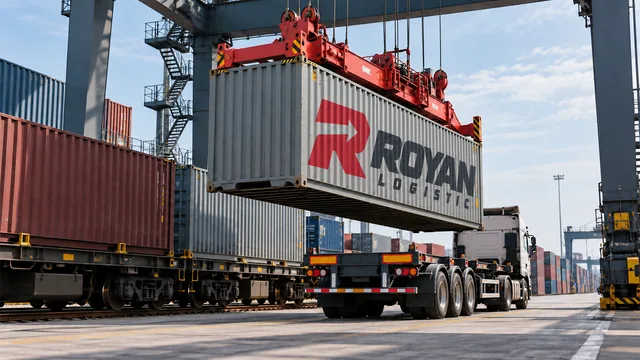
Iran's rail network links the Persian Gulf ports with Tehran, Mashhad, Tabriz and the land borders, which makes rail a natural choice for heavy and long-distance cargo. For bulk materials, steel, polymers and containers travelling to Central Asia, China or Russia, rail can offer a stable cost and a predictable schedule. Royan Logistic plans the rail leg together with the road legs at both ends, so you deal with one plan rather than several carriers.
Main rail corridors from Iran
| Corridor | Route | Usually suits |
|---|---|---|
| North–South (INSTC) | Bandar Abbas – Tehran – Caspian region – Astara – Azerbaijan – Russia, or via Caspian ports by sea | Cargo between the Gulf, India and Russia |
| East: Central Asia and China | Iran – Turkmenistan (Incheh Borun or Sarakhs) – Kazakhstan / Uzbekistan – China | Containers and bulk cargo to and from Central Asia and China |
| West: Turkey | Iran – Razi – Kapıköy – Lake Van ferry (Van–Tatvan) – Turkish rail network | Heavy, non-urgent cargo to and from Turkey |
The North–South corridor (INSTC)
The International North–South Transport Corridor connects India and the Persian Gulf with Russia through Iran. Cargo arriving at Bandar Abbas can travel north by rail and continue to Russia either via Azerbaijan (Astara) or across the Caspian Sea from ports such as Amirabad or Anzali. The Rasht–Astara rail link is still under construction, so on the western branch this section is currently covered by road. We compare the rail, Caspian and road options for each shipment; see also our Russia freight page.
Iran–Turkmenistan–Kazakhstan–China
On the eastern route, trains leave Iran at Incheh Borun or Sarakhs, cross Turkmenistan and continue to Kazakhstan, Uzbekistan or onward to China. Iran and China use standard gauge (1435 mm), while Turkmenistan and Kazakhstan use broad gauge (1520 mm), so cargo is transshipped or bogies are exchanged at the gauge-change points. As an approximate guide, rail from Iran to Almaty takes around 10–14 days, depending on wagon availability and border handling. Country details are on our Central Asia and China freight pages.
Iran–Turkey rail link
Rail freight between Iran and Turkey crosses at Razi–Kapıköy and uses the train ferry on Lake Van between Van and Tatvan before joining the Turkish network. It can suit heavy cargo that is not time-critical. For most general cargo, road freight remains faster; see our Iran–Turkey freight page.
Wagons, containers and terminals
- Containers: 20' and 40' containers for general and palletised cargo.
- Covered wagons: bagged or palletised cargo such as polymers and food products.
- Flat wagons and gondolas: steel, heavy equipment and bulk materials.
- Tank wagons: liquid cargo, subject to the applicable dangerous goods rules.
The road legs to the loading terminal and from the arrival terminal to the consignee are included in the plan. When rail is combined with sea or road in one shipment, we treat it as an intermodal plan. For a general comparison, see our article on the advantages of rail freight.
Documents
- Rail consignment note: SMGS on routes to Central Asia, Russia and China, CIM or a combined CIM/SMGS note on other routes, depending on the corridor
- Commercial invoice and packing list
- Certificate of origin and product-specific certificates
- Export and import customs declarations; transit documents for transit countries
Payment and documentation requirements are reviewed for each shipment.
What to send for a quote
- Loading and delivery addresses, or the terminals if you already know them
- Cargo type, HS code if known, and packaging
- Weight, volume and number of units; whether you need containers or wagons
- Target loading date
Send the details through our contact page and we will compare the rail option with road and sea alternatives.
Frequently asked questions
Which rail routes do you use from Iran?
The North–South corridor (INSTC) towards Azerbaijan and Russia, the eastern line via Turkmenistan to Kazakhstan, Uzbekistan and China, and the Iran–Turkey link via Razi–Kapıköy and Lake Van. We choose the corridor for each shipment.
Why is there transshipment at the Turkmenistan border?
Iran uses standard gauge (1435 mm) and Turkmenistan and Kazakhstan use broad gauge (1520 mm). At the gauge-change points cargo is transshipped or wagon bogies are exchanged.
How long does rail from Iran to Kazakhstan take?
As an approximate guide, around 10–14 days to Almaty, depending on wagon availability, border handling and the season. We give a specific plan when we quote.
Is there rail to Russia through Iran?
Yes, on the INSTC. Cargo travels north by rail and continues via Azerbaijan or across the Caspian Sea. As the Rasht–Astara rail link is still under construction, part of the western branch is currently covered by road.
Which cargo suits rail best?
Heavy and long-distance cargo such as steel, minerals, polymers, grain and containers, especially when cost and a predictable schedule matter more than speed.
Do you arrange the road legs to and from the terminals?
Yes. Pick-up to the loading terminal and delivery from the arrival terminal are part of the plan, so the shipment works door to door.